
Week 24: June 14-20, 2026 - Paul: An Unlikely Apostle
This week’s daily readings:
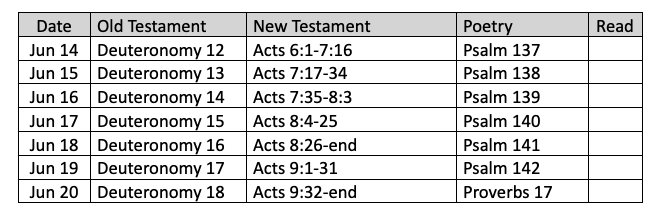
June 14-20, 2026
This week’s devotional:
Paul: An Unlikely Apostle
by The Rev. Justin Elerath
Scripture:
When he came to Jerusalem, he [Paul] tried to join the disciples, but they were all afraid of him, not believing that he really was a disciple.
— Acts 9:26 (NIV)
Reflection:
In regulated industries, a routine part of your work is preparing for and participating in audits. Audits are called for by a regulatory body such as the FDA, or FAA, or several others, depending on the industry and location being represented. Usually, in preparation for an audit, you will receive training (particularly if you have never or rarely participated in one before). To summarize the instructions that are given almost universally, you are to “Answer only the question that is asked,” “Do not offer information that wasn’t asked,” “Be comfortable with silence,” “Don’t guess; if you don’t know, admit it.” They teach ways to be truthful without extending the conversation any longer than is necessary. Speed is essential so that we can move onto the next topic, end the conversation, and ultimately get back to our day jobs.
Looking first at Acts chapter 7, Stephen was given the opportunity to defend himself in order to protect his reputation—and even his life. The high priest asked him, “Are these charges true?” Stephen’s response was hardly a defense of his innocence. He was accused of blasphemy: words against Moses and against God. He was facing accusations from false witnesses. I think the palatable thing would have been to deny the accusations and provide no additional information. Bearing witness in front of the Sanhedrin, he had a captive audience of both Sadducees and Pharisees. The high priest was likely Caiaphas who presided over Jesus’ trial. The allegations against Stephen don’t seem outrageous; there is an element of truth without being fully true. But why, oh why, didn’t Stephen just answer the question that was asked, assert the truth, and hope that the conversation would move on? Why would he dig himself in deeper by turning the accusation back on his audience?
Being on mission is hard. It can be tempting to be ashamed of the Gospel because it causes offense. You’re putting yourself on the line. You never know if you are going to compromise your reputation, your livelihood, your freedom, or even your life if you speak boldly. But that is what we are called to do: to make a bold proclamation of Jesus.
Stephen’s speech to the Sanhedrin ultimately resulted in his death. Would it have been better if he had been quiet? We don’t know. Not only was Stephen stoned to death as a result of his testimony, but Saul approved of having him killed.
When Jesus met Saul on the road to Damascus (later on in chapter 9), he was calling Saul/Paul to his true purpose: the purpose which God prepared in advance for him to do. This transformation did not come with instant public acceptance. Paul needed help to develop a new reputation, but God placed people in his life to do that. He had a testimony that told of an obvious life transformation, and he shared it with those who would listen. Are you willing to listen when an unlikely convert is sharing their testimony? Do you doubt God’s current work in someone’s life because of their old life? We should look at new believers with the eyes of God rather than through the lens of self-righteousness—something we can only do through the work of the Holy Spirit.
Prayer:
Almighty God, is there nothing you can’t do?! I marvel at the story of Saul’s conversion: how you changed him for your own purposes so that he, as Paul, would spread the Gospel to the Gentiles. Help us to believe that by your power lives can be changed! I pray that you will work miracles with me, too, Lord. Let me see your glorious light and hear Christ’s voice speaking to me. Fill me with your Holy Spirit. Send me where you would have me go for the sake of your glory and enable me to speak boldly as I share the truth of the Gospel. Amen.